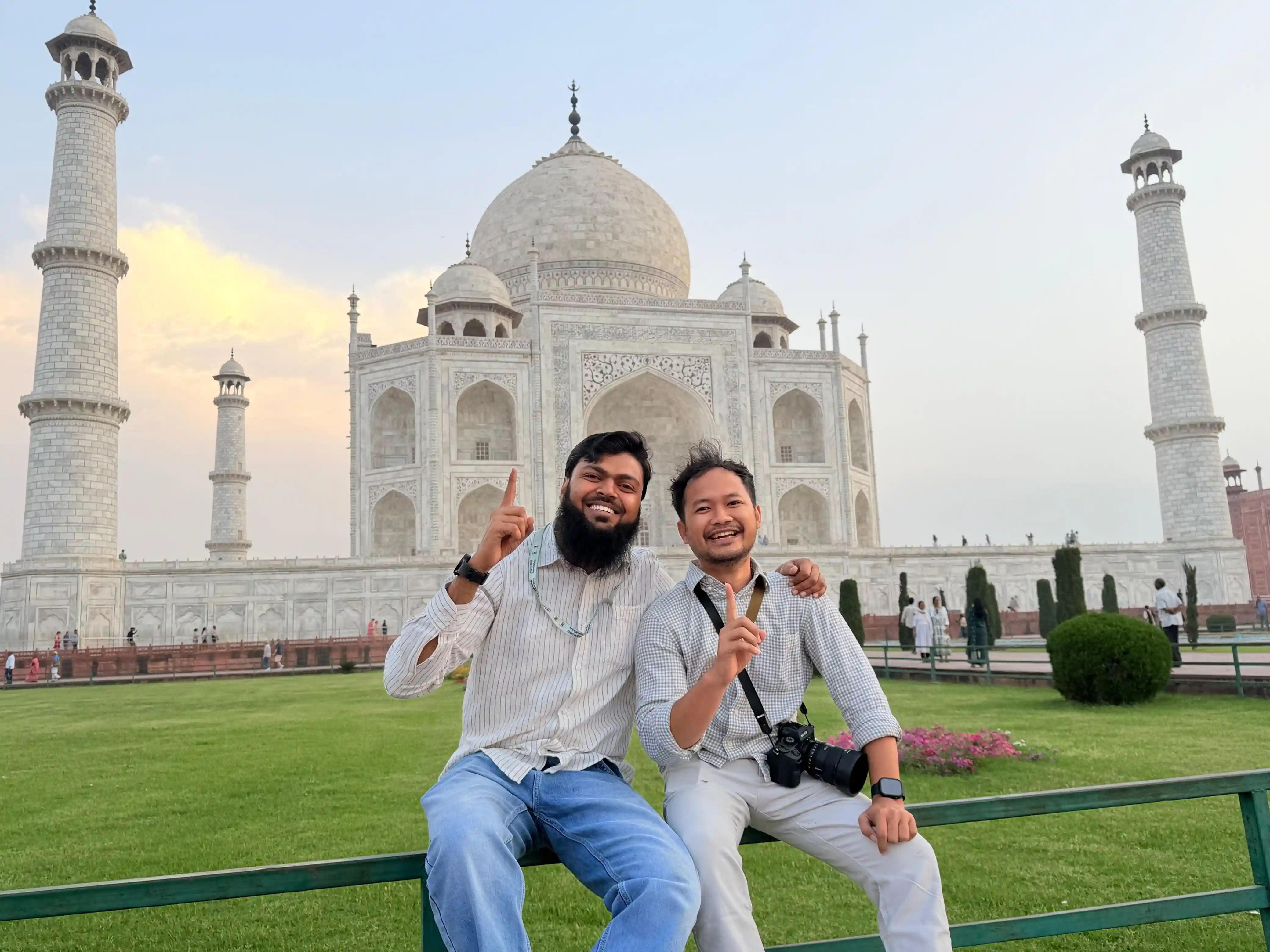
I have been to the Taj Mahal over 500 times.
I know exactly which mornings the marble turns the colour of a ripe peach. I know which months the sky is a flat, washed-out white that kills every photograph. I know which days the queue at the East Gate stretches so far back that you spend your first hour in Agra staring at the back of someone's head instead of one of the world's greatest buildings.
This is not a generic travel article written from a desk in another country. This is what I tell every guest who books a Taj Mahal sunrise tour with me before they arrive — the honest, unfiltered truth about when to come, and when not to.
First — the one thing that matters most
Before we talk seasons or months, there is a single decision that changes everything about your Taj Mahal experience: do you go at sunrise, or do you go later?
"The Taj Mahal at 6:30 AM and the Taj Mahal at 11:00 AM are almost two different places. One is a private dream. The other is a crowded monument."
I mean this genuinely. I have stood at the main platform at 6:45 AM with a guest from Madrid — just the two of us and maybe thirty other people spread across the entire garden. The marble was pink. The sky behind the minarets was the colour of apricots. She cried. I have also brought guests at 10 AM in March and watched them struggle to get a clear photograph because there were two thousand people between them and the main arch.
Sunrise is not a tourist cliché. It is simply the only time the Taj Mahal belongs to you.
🌅 Sunrise Visit — Key Facts
- East Gate opens 30 minutes before official sunrise
- Taj Mahal opens at sunrise (no pre-sunrise access to the main complex)
- Best light lasts 45–60 minutes after sunrise
- By 8:30 AM, coach groups begin arriving
- By 9:30 AM, all three gates are crowded
- East Gate has the shortest queue in the early morning
Sunrise vs sunset: which is actually better?
Both are beautiful. They are not the same experience, and for most travellers one is clearly the smarter choice.
| Sunrise | Sunset | |
|---|---|---|
| Crowds | Minimal | Heavy |
| Light on marble | Soft pink, cool tones | Warm orange, gold tones |
| Time pressure | Relaxed — full morning ahead | Tight — site closes at dusk |
| Photography | Best — clean frames, soft shadows | Good, but crowds enter most shots |
| Best for | Photographers, first-time visitors | Second visits, quick add-on to a day tour |
My honest take, after 500+ visits at both ends of the day: if you can only pick one, pick sunrise. Sunset is a lovely bonus if you are already in Agra for the afternoon, not a substitute for the morning light.
The best season to visit the Taj Mahal
Agra has three distinct seasons and they could not be more different from each other.
| Season | Months | Temperature | Verdict |
|---|---|---|---|
| Winter | Oct – Feb | 8°C – 25°C | Best |
| Spring | Mar – Apr | 22°C – 38°C | Acceptable |
| Summer | May – Jun | 38°C – 47°C | Avoid |
| Monsoon | Jul – Sep | 28°C – 38°C | Underrated |
October to February — the clear winner
This is when Agra is at its best. The air is cool, the sky is a deep blue that makes the white marble almost luminous, and sunrise comes at a civilised hour — between 6:30 and 7:00 AM depending on the month. November and December mornings sometimes have a light mist that sits in the Yamuna river behind the Taj — I have seen guests with good cameras capture images in those conditions that look like oil paintings.
If I had to choose one single month, I would say November or February. The light is extraordinary, the crowds are lower than December or January (which are peak tourist months), and the temperatures are perfect for walking the full complex without exhaustion.
March and April — fine, but going
March is still good in the first two weeks. By late March the heat starts building and by April, noon at the Taj Mahal means the marble is radiating heat back at you like an oven. Go at sunrise and you will be fine. Go at midday and you will be miserable.
May and June — honest advice: reconsider
I will not sugarcoat this. I have taken guests in May when temperatures hit 44°C. The marble burns through shoes. The air shimmers. Nobody is comfortable. If this is the only time you can travel, go as early as the gates open and plan to leave by 8:30 AM. But if you have any flexibility, use it.
July to September — the secret season
This surprises many people. Monsoon Agra is genuinely beautiful. The heat breaks, everything turns green, and the Taj Mahal against a dramatic storm sky is something most tourists never see. The gardens are lush. Crowds are at their annual lowest. The risk is that heavy rain or fog can reduce visibility, and some mornings are overcast. But on a clear monsoon morning, the Taj Mahal looks like it is floating. I have seen photographs from July that beat anything taken in December.
Best month to visit the Taj Mahal, month by month
If you want a single answer: the best month to visit the Taj Mahal is November or February. Here is how every month actually compares, based on what I see on the ground each year.
| Month | Weather | Crowds | Verdict |
|---|---|---|---|
| January | Cool, occasional morning fog | Peak | Good |
| February | Mild, clear skies | High | Best |
| March | Warming quickly | Moderate | Good |
| April | Hot by midday | Low | Sunrise only |
| May | Very hot (up to 44°C) | Low | Avoid |
| June | Extreme heat | Low | Avoid |
| July | Monsoon, lush, humid | Lowest of the year | Underrated |
| August | Monsoon, green | Lowest of the year | Underrated |
| September | Monsoon tapering off | Low | Good |
| October | Cooling, clear | Rising | Excellent |
| November | Cool, crisp, occasional mist | Moderate | Best |
| December | Cool, sometimes foggy mornings | Peak (holidays) | Good |
Weekday vs weekend — this matters more than most guides tell you
The Taj Mahal is closed on Fridays. This confuses some visitors — a Muslim monument closed on the Islamic day of prayer so that the mosque inside can be used for Jumu'ah prayers. Plan around it.
On Saturdays and Sundays, something significant happens: domestic tourists from Delhi, Mathura, and Lucknow arrive in large numbers. The queues at all three gates are longer. The main garden path is busier. If you are visiting on a weekend, sunrise becomes even more non-negotiable — it is the only window before the day-trippers arrive.
Tuesday, Wednesday, and Thursday mornings at sunrise — this is the sweet spot. Minimum crowds, maximum light, and the whole experience feels like it was made for you.
A practical timing guide — hour by hour
- 5:45 AM — Arrive at East Gate. Small queue, mostly photographers and guided tours.
- 6:00–6:15 AM — Gates open. Walk directly to the main platform.
- 6:15–7:15 AM — Golden hour. The light is perfect, crowds are minimal. This is the hour.
- 7:15–8:00 AM — Still lovely. Light softens. A few more visitors arriving.
- 8:00–9:00 AM — Noticeably busier. Still manageable if you know where to position.
- 9:00 AM onwards — Coach groups. Queue at the main mausoleum entrance. Photographs become difficult without strangers in frame.
- 11:00 AM – 3:00 PM — Peak crowds and (in summer) peak heat. Avoid if possible.
- 4:00 PM – close — Afternoon light is warm and beautiful. Crowds thin slightly from peak. Sunset is stunning but the site closes at dusk so timing is tight.
Taj Mahal opening time and ticket price (2026)
The Taj Mahal opens around 30 minutes before official sunrise and closes around 30–45 minutes before sunset, every day of the week except Friday — so exact hours shift a little through the year with the sunrise/sunset calendar. In practice, expect roughly 6:00 AM to 6:30 PM depending on the season.
| Category | Complex Entry | + Main Mausoleum |
|---|---|---|
| Indian citizens | ₹50 | ₹250 total |
| SAARC / BIMSTEC nationals | ₹540 | ₹740 total |
| Foreign tourists | ₹1,100 | ₹1,300 total |
| Children under 15 | Free (all nationalities) | |
Figures above are current as of 2026 and set by the Archaeological Survey of India (ASI); they can change, so I'd always recommend a quick check on the official tajmahal.gov.in or asiagracircle.in booking portals close to your travel date.
Ticket tips from someone who does this weekly
- Book online in advance during November–February peak season — sunrise slots do sell out.
- Carry a physical ID. Foreign visitors need a passport; Indian visitors need Aadhaar, a voter ID, or a driving licence.
- Skip the mausoleum add-on if you're short on time — the base ticket already includes the gardens, the main platform, and every classic photo angle.
- Booking a guided tour removes the ticket logistics entirely — I handle entry arrangements for every guest.
- Watch for touts near the gates selling unofficial "tourist cards." Buy only from official counters or verified online portals.
Which entry gate should you use?
The Taj Mahal has three gates, and picking the right one changes your morning.
- East Gate (Shilpgram Gate) — shortest queue at sunrise, my default recommendation for early visits.
- West Gate (near Saheli Burj) — busier with domestic tour groups, typically from mid-morning onward.
- South Gate — currently exit-only; no entry is permitted from this gate.
There are separate queues for Indian and foreign visitors at each open gate, clearly signposted. For a sunrise visit, arrive at the East Gate — it consistently has the shortest wait in the first hour after opening.
What about the Taj Mahal by moonlight?
This is one of the most common questions I receive. Yes, the Taj Mahal offers limited night viewing on five nights around the full moon each month — the night of the full moon itself, two nights before, and two nights after (excluding Fridays). Viewing is from the Mehtab Bagh (the garden on the opposite bank of the Yamuna) or from a small enclosure near the west gate, and tickets must be booked at least 24 hours in advance.
My honest opinion: it is beautiful, but the experience is very controlled — you are in a group, limited to around 50 people per 30-minute batch, and no photography is allowed inside (though people try). If you have the opportunity, do it as an addition to a sunrise visit, not instead of one.
Photography tips for the Taj Mahal
- Shoot the sunrise window. The 6:15–7:15 AM golden hour gives the softest, most even light on the marble.
- Use the reflecting pool on the main platform for the classic symmetrical shot — arrive early before footprints and crowds disturb the water's stillness.
- Bring a polarising filter if you shoot with a DSLR or mirrorless camera — it cuts glare off the white marble in strong daylight.
- Drones are strictly prohibited inside and around the complex — don't risk it, security enforces this closely.
- Try the Mehtab Bagh across the river for a wide, uncluttered frame of the Taj Mahal with no crowds in shot, especially at sunset.
- Monsoon mornings (July–September) against a dramatic sky produce some of the most striking, least-photographed images of the monument.
Common tourist mistakes to avoid
- Arriving after 8 AM expecting a quiet sunrise experience — by then the light and the calm are both gone.
- Planning a visit on Friday — the Taj Mahal is closed every Friday for prayers; it's a firm closure, not a soft guideline.
- Buying tickets from touts outside the gates — unofficial "tourist cards" often exclude the mausoleum entry and cause problems at the queue.
- Forgetting a physical ID — an online e-ticket alone is not accepted without the ID used to book it.
- Visiting only in December–January because it "sounds like winter" — these are the most crowded months of the cool season; November and February offer similar weather with fewer people.
- Skipping Agra Fort and Mehtab Bagh — both pair naturally with a Taj Mahal morning and are almost always uncrowded.
Ready to see the Taj Mahal at its finest?
I offer private sunrise tours from Agra — East Gate entry, golden hour photography, Agra Fort, and Mehtab Bagh. Everything arranged. You just arrive.
See Taj Mahal Sunrise Tour →My honest final recommendation
If you are planning a trip to India and the Taj Mahal is on your list — which it should be — here is exactly what I would tell my own family:
- Come between November and February
- Visit on a Tuesday, Wednesday, or Thursday
- Enter through the East Gate at sunrise
- Spend your first hour on the main platform, then explore the interior, the mosque, and the gardens as the light shifts
- Leave before 9:30 AM or stay until the afternoon — avoid the 10 AM to 2 PM window in any season
- Combine with Agra Fort and Mehtab Bagh the same day — they are both extraordinary and almost always uncrowded
The Taj Mahal is one of those places that genuinely lives up to its reputation — but only if you approach it with intention. Timing is everything. The same building on the same day, seen at the right moment vs the wrong one, can be a transcendent experience or a frustrating exercise in crowd navigation. If Agra is just one stop on a longer trip, it's also worth reading how the Golden Triangle tour connects Delhi, Agra, and Jaipur.
I have spent years helping people have the first kind of experience. It is why I do this work — and it's the same approach I take as a private tour guide across India, not just in Agra.
Frequently Asked Questions

Let me take you at exactly the right moment.
East Gate sunrise entry · Agra Fort · Mehtab Bagh · 10 edited photographs · Bilingual English & Spanish. WhatsApp me directly to check availability.
WhatsApp Kamran →He visitado el Taj Mahal más de 500 veces.
Sé exactamente qué mañanas el mármol toma el color de un melocotón maduro. Sé qué meses el cielo es blanco y apagado, arruinando cualquier fotografía. Sé qué días la cola en la Puerta Este es tan larga que pasas la primera hora en Agra mirando la nuca de alguien en vez de uno de los edificios más grandes del mundo.
Esto no es un artículo turístico genérico escrito desde un escritorio en otro país. Esto es lo que le digo a cada huésped que reserva un tour al amanecer en el Taj Mahal conmigo antes de llegar — la verdad honesta y sin filtros sobre cuándo venir, y cuándo no.
Primero — lo único que realmente importa
Antes de hablar de temporadas o meses, hay una sola decisión que cambia todo sobre tu experiencia en el Taj Mahal: ¿vas al amanecer o más tarde?
"El Taj Mahal a las 6:30 de la mañana y el Taj Mahal a las 11:00 son casi dos lugares distintos. Uno es un sueño privado. El otro es un monumento lleno de gente."
Lo digo en serio. He estado en la plataforma principal a las 6:45 AM con una huésped de Madrid — solo nosotros dos y quizás treinta personas más repartidas por todo el jardín. El mármol era rosa. El cielo detrás de los minaretes tenía el color de los albaricoques. Ella lloró. También he llevado a huéspedes a las 10 AM en marzo y los he visto luchar por conseguir una fotografía limpia porque había dos mil personas entre ellos y el arco principal.
El amanecer no es un cliché turístico. Es simplemente el único momento en que el Taj Mahal te pertenece a ti.
🌅 Visita al Amanecer — Datos Clave
- La Puerta Este abre 30 minutos antes del amanecer oficial
- El Taj Mahal abre al amanecer (no hay acceso previo al complejo principal)
- La mejor luz dura 45–60 minutos después del amanecer
- A las 8:30 AM empiezan a llegar los grupos de autobús
- A las 9:30 AM las tres puertas ya están concurridas
- La Puerta Este tiene la cola más corta en la mañana temprana
Amanecer vs atardecer: ¿cuál es mejor?
Ambos son hermosos. No son la misma experiencia, y para la mayoría de los viajeros una opción es claramente más inteligente.
| Amanecer | Atardecer | |
|---|---|---|
| Multitudes | Mínimas | Numerosas |
| Luz sobre el mármol | Rosa suave, tonos fríos | Naranja cálido, tonos dorados |
| Presión de tiempo | Relajada — toda la mañana por delante | Ajustada — el sitio cierra al anochecer |
| Fotografía | La mejor — encuadres limpios, sombras suaves | Buena, pero las multitudes entran en la mayoría de las fotos |
| Ideal para | Fotógrafos, primeras visitas | Segundas visitas, complemento rápido de un tour |
Mi opinión honesta, después de más de 500 visitas en ambos extremos del día: si solo puedes elegir uno, elige el amanecer. El atardecer es un lindo complemento si ya estás en Agra por la tarde, no un sustituto de la luz de la mañana.
La mejor temporada para visitar el Taj Mahal
Agra tiene tres estaciones bien diferenciadas y no podrían ser más distintas entre sí.
| Temporada | Meses | Temperatura | Veredicto |
|---|---|---|---|
| Invierno | Oct – Feb | 8°C – 25°C | La mejor |
| Primavera | Mar – Abr | 22°C – 38°C | Aceptable |
| Verano | May – Jun | 38°C – 47°C | Evitar |
| Monzón | Jul – Sep | 28°C – 38°C | Infravalorada |
Octubre a febrero — el ganador claro
Esta es la mejor época para Agra. El aire es fresco, el cielo es de un azul profundo que hace que el mármol blanco casi brille, y el amanecer llega a una hora razonable — entre las 6:30 y las 7:00 según el mes. Las mañanas de noviembre y diciembre a veces tienen una ligera niebla que se asienta sobre el río Yamuna detrás del Taj — he visto a huéspedes con buenas cámaras capturar imágenes en esas condiciones que parecen pinturas al óleo.
Si tuviera que elegir un solo mes, diría noviembre o febrero. La luz es extraordinaria, el número de visitantes es menor que en diciembre o enero (que son los meses pico), y las temperaturas son perfectas para recorrer todo el complejo sin agotarse.
Marzo y abril — bien, pero con calor creciente
Marzo sigue siendo bueno en las primeras dos semanas. A finales de marzo el calor empieza a aumentar y en abril, el mediodía en el Taj Mahal significa que el mármol te devuelve el calor como un horno. Ve al amanecer y estarás bien. Ve a mediodía y lo pasarás mal.
Mayo y junio — consejo honesto: reconsidera
No lo voy a suavizar. He llevado a huéspedes en mayo cuando las temperaturas llegaban a 44°C. El mármol quema a través de los zapatos. El aire tiembla. Nadie está cómodo. Si este es el único momento en que puedes viajar, ve tan pronto como abran las puertas y planifica salir antes de las 8:30 AM. Pero si tienes alguna flexibilidad, úsala.
Julio a septiembre — la temporada secreta
Esto sorprende a mucha gente. El Agra del monzón es genuinamente hermoso. El calor cede, todo se vuelve verde, y el Taj Mahal contra un cielo dramático de tormenta es algo que la mayoría de los turistas nunca ve. Los jardines están exuberantes. Las multitudes están en su mínimo anual. El riesgo es que la lluvia intensa o la niebla pueden reducir la visibilidad, y algunas mañanas están nubladas. Pero en una mañana clara de julio, el Taj Mahal puede ser extraordinario.
Mejor mes para visitar el Taj Mahal, mes a mes
Si quieres una sola respuesta: el mejor mes para visitar el Taj Mahal es noviembre o febrero. Así se compara cada mes en la práctica, según lo que veo cada año sobre el terreno.
| Mes | Clima | Multitudes | Veredicto |
|---|---|---|---|
| Enero | Fresco, niebla matutina ocasional | Pico | Bueno |
| Febrero | Templado, cielos despejados | Alta | La mejor |
| Marzo | Calentando rápido | Moderada | Bueno |
| Abril | Caluroso al mediodía | Baja | Solo amanecer |
| Mayo | Muy caluroso (hasta 44°C) | Baja | Evitar |
| Junio | Calor extremo | Baja | Evitar |
| Julio | Monzón, exuberante, húmedo | La más baja del año | Infravalorada |
| Agosto | Monzón, verde | La más baja del año | Infravalorada |
| Septiembre | Monzón disminuyendo | Baja | Bueno |
| Octubre | Refrescando, despejado | Aumentando | Excelente |
| Noviembre | Fresco, nítido, niebla ocasional | Moderada | La mejor |
| Diciembre | Fresco, a veces con niebla matutina | Pico (vacaciones) | Bueno |
Entre semana vs fin de semana — esto importa más de lo que te dicen
El Taj Mahal cierra los viernes. Esto confunde a algunos visitantes — un monumento musulmán cerrado el día de oración islámico para que la mezquita interior pueda usarse para la oración del Jumu'ah. Tenlo en cuenta al planificar.
Los sábados y domingos llegan en grandes números turistas nacionales desde Delhi, Mathura y Lucknow. Las colas en las tres puertas son más largas. El camino principal del jardín está más concurrido. Si visitas en fin de semana, el amanecer se vuelve aún más imprescindible — es la única ventana antes de que lleguen los excursionistas del día.
Mañanas de martes, miércoles y jueves al amanecer — este es el punto dulce. Mínimas multitudes, luz máxima, y toda la experiencia parece hecha para ti.
Guía práctica de horarios — hora por hora
- 5:45 AM — Llega a la Puerta Este. Cola pequeña, principalmente fotógrafos y tours privados.
- 6:00–6:15 AM — Abren las puertas. Dirígete directamente a la plataforma principal.
- 6:15–7:15 AM — Hora dorada. La luz es perfecta, las multitudes son mínimas. Esta es la hora.
- 7:15–8:00 AM — Todavía precioso. La luz se suaviza. Llegan algunos visitantes más.
- 8:00–9:00 AM — Notablemente más concurrido. Aún manejable si sabes dónde posicionarte.
- 9:00 AM en adelante — Grupos de autobús. Cola en la entrada principal al mausoleo. Las fotografías sin extraños en el encuadre se vuelven difíciles.
- 11:00 AM – 3:00 PM — Pico de multitudes y (en verano) pico de calor. Evitar si es posible.
- 4:00 PM – cierre — La luz de la tarde es cálida y hermosa. Las multitudes se reducen ligeramente desde el pico. El atardecer es impresionante pero el sitio cierra al anochecer, así que el tiempo es justo.
Horario de apertura y precio de entrada del Taj Mahal (2026)
El Taj Mahal abre alrededor de 30 minutos antes del amanecer oficial y cierra entre 30–45 minutos antes del atardecer, todos los días excepto los viernes — así que el horario exacto varía un poco a lo largo del año según el calendario de amanecer/atardecer. En la práctica, espera aproximadamente de 6:00 AM a 6:30 PM según la temporada.
| Categoría | Entrada al Complejo | + Mausoleo Principal |
|---|---|---|
| Ciudadanos indios | ₹50 | ₹250 total |
| Ciudadanos SAARC / BIMSTEC | ₹540 | ₹740 total |
| Turistas extranjeros | ₹1,100 | ₹1,300 total |
| Menores de 15 años | Gratis (todas las nacionalidades) | |
Las cifras anteriores son vigentes en 2026 y están fijadas por el Archaeological Survey of India (ASI); pueden cambiar, así que siempre recomiendo verificar en los portales oficiales tajmahal.gov.in o asiagracircle.in cerca de tu fecha de viaje.
Consejos de tickets de alguien que hace esto cada semana
- Reserva en línea con anticipación durante la temporada alta de noviembre–febrero — los horarios de amanecer sí se agotan.
- Lleva una identificación física. Los visitantes extranjeros necesitan pasaporte; los indios necesitan Aadhaar, cédula de votante o licencia de conducir.
- Omite el complemento del mausoleo si tienes poco tiempo — el ticket base ya incluye los jardines, la plataforma principal y todos los ángulos fotográficos clásicos.
- Reservar un tour guiado elimina por completo la logística de tickets — yo me encargo de la entrada de cada huésped.
- Cuidado con los revendedores cerca de las puertas que venden "tarjetas turísticas" no oficiales. Compra solo en ventanillas oficiales o portales en línea verificados.
¿Qué puerta de entrada deberías usar?
El Taj Mahal tiene tres puertas, y elegir la correcta cambia tu mañana.
- Puerta Este (Puerta Shilpgram) — la cola más corta al amanecer, mi recomendación por defecto para visitas tempranas.
- Puerta Oeste (cerca de Saheli Burj) — más concurrida con grupos turísticos nacionales, generalmente desde media mañana.
- Puerta Sur — actualmente solo de salida; no se permite la entrada por esta puerta.
Hay colas separadas para visitantes indios y extranjeros en cada puerta abierta, claramente señalizadas. Para una visita al amanecer, llega a la Puerta Este — consistentemente tiene la espera más corta en la primera hora después de la apertura.
¿Y el Taj Mahal a la luz de la luna?
Esta es una de las preguntas más frecuentes que recibo. Sí, el Taj Mahal ofrece visitas nocturnas limitadas en cinco noches alrededor de la luna llena cada mes — la noche de la luna llena en sí, dos noches antes y dos noches después (excepto viernes). La visita es desde el Mehtab Bagh (el jardín en la orilla opuesta del Yamuna) o desde un pequeño recinto cerca de la puerta oeste, y los tickets deben reservarse con al menos 24 horas de anticipación.
Mi opinión honesta: es hermoso, pero la experiencia es muy controlada — estás en grupo, limitado a unas 50 personas por tanda de 30 minutos, y no se permiten cámaras dentro (aunque la gente lo intenta). Si tienes la oportunidad, hazlo como complemento a una visita al amanecer, no en lugar de ella.
Consejos de fotografía para el Taj Mahal
- Aprovecha la ventana del amanecer. La hora dorada de 6:15–7:15 AM da la luz más suave y uniforme sobre el mármol.
- Usa el estanque reflectante de la plataforma principal para la clásica foto simétrica — llega temprano antes de que las pisadas y las multitudes alteren la quietud del agua.
- Lleva un filtro polarizador si usas cámara DSLR o mirrorless — reduce el reflejo del mármol blanco con luz fuerte.
- Los drones están estrictamente prohibidos dentro y alrededor del complejo — no te arriesgues, la seguridad lo controla de cerca.
- Prueba el Mehtab Bagh al otro lado del río para un encuadre amplio y despejado del Taj Mahal sin multitudes, especialmente al atardecer.
- Las mañanas de monzón (julio–septiembre) contra un cielo dramático producen algunas de las imágenes más llamativas y menos fotografiadas del monumento.
Errores comunes de los turistas
- Llegar después de las 8 AM esperando una experiencia tranquila de amanecer — para entonces la luz y la calma ya se han ido.
- Planificar una visita en viernes — el Taj Mahal cierra todos los viernes por las oraciones; es un cierre firme, no una sugerencia.
- Comprar tickets a revendedores fuera de las puertas — las "tarjetas turísticas" no oficiales a menudo excluyen la entrada al mausoleo y causan problemas en la cola.
- Olvidar una identificación física — un e-ticket en línea por sí solo no se acepta sin la identificación usada para reservarlo.
- Visitar solo en diciembre–enero porque "suena a invierno" — estos son los meses más concurridos de la temporada fresca; noviembre y febrero ofrecen un clima similar con menos gente.
- Omitir el Fuerte de Agra y el Mehtab Bagh — ambos combinan naturalmente con una mañana en el Taj Mahal y casi siempre están tranquilos.
¿Listo para ver el Taj Mahal en su mejor momento?
Ofrezco tours privados al amanecer desde Agra — entrada por la Puerta Este, fotografía en hora dorada, Fuerte de Agra y Mehtab Bagh. Todo organizado. Tú solo llegas.
Ver Tour Amanecer Taj Mahal →Mi recomendación final honesta
Si estás planificando un viaje a India y el Taj Mahal está en tu lista — que debería estarlo — aquí está exactamente lo que le diría a mi propia familia:
- Ven entre noviembre y febrero
- Visita en martes, miércoles o jueves
- Entra por la Puerta Este al amanecer
- Pasa tu primera hora en la plataforma principal, luego explora el interior, la mezquita y los jardines mientras la luz cambia
- Sal antes de las 9:30 AM o quédate hasta la tarde — evita la ventana de 10 AM a 2 PM en cualquier temporada
- Combina con el Fuerte de Agra y el Mehtab Bagh el mismo día — ambos son extraordinarios y casi siempre tranquilos
El Taj Mahal es uno de esos lugares que genuinamente está a la altura de su reputación — pero solo si te aproximas a él con intención. El momento lo es todo. El mismo edificio el mismo día, visto en el momento correcto versus el incorrecto, puede ser una experiencia trascendente o un frustrante ejercicio de navegación entre multitudes. Si Agra es solo una parada de un viaje más largo, vale la pena leer cómo el tour del Triángulo Dorado conecta Delhi, Agra y Jaipur.
He pasado años ayudando a personas a tener el primer tipo de experiencia. Es por eso que hago este trabajo — y es el mismo enfoque que aplico como guía de tours privados en toda India, no solo en Agra.
Preguntas Frecuentes
Déjame llevarte en exactamente el momento correcto.
Entrada por la Puerta Este al amanecer · Fuerte de Agra · Mehtab Bagh · 10 fotografías editadas · Bilingüe inglés y español. Escríbeme directamente por WhatsApp para verificar disponibilidad.
WhatsApp a Kamran →